
There is a particular kind of child who reads the back of the cereal box, the football scores and the instructions for the new game — and nothing else. Give them a novel and it comes back unopened. Give them anything with a scoreboard in it and they will read it standing up in the kitchen.
If that is your child, the trick is not to find a book about sport. There are plenty of those, and most of them are still novels: somebody else's season, told to you. The trick is to find a book where your child is the one making the calls. That is what these two do.
The Game-Winning Shot — basketball
You are Matt. The basketball presses against your chest as if it already knew what was coming. It is the first day of the School Championship and Coach Sarah has a secret: someone is about to be named captain. You? Your best friend Leo?
The Blue Ridge Hawks have five rivals between them and the trophy, and far too many decisions for a single season. Do you take on the captain's challenge or hand it to Leo? Do you bite your tongue or answer back to the captain who plays dirty? Do you take the final three yourself, or pass to the teammate who is open? Every choice changes the game, and every game changes your path.
What we like about it as a book for sporty kids is that the decisions are the ones they actually face on a court: whether to shoot or pass, whether to argue with a referee, what to do when a teammate is having a bad day. More than 12 endings — some finish with the trophy in your hands, some with a lesson, and one with a surprise trophy. The Game-Winning Shot on Amazon.
Road to Nationals — flag football
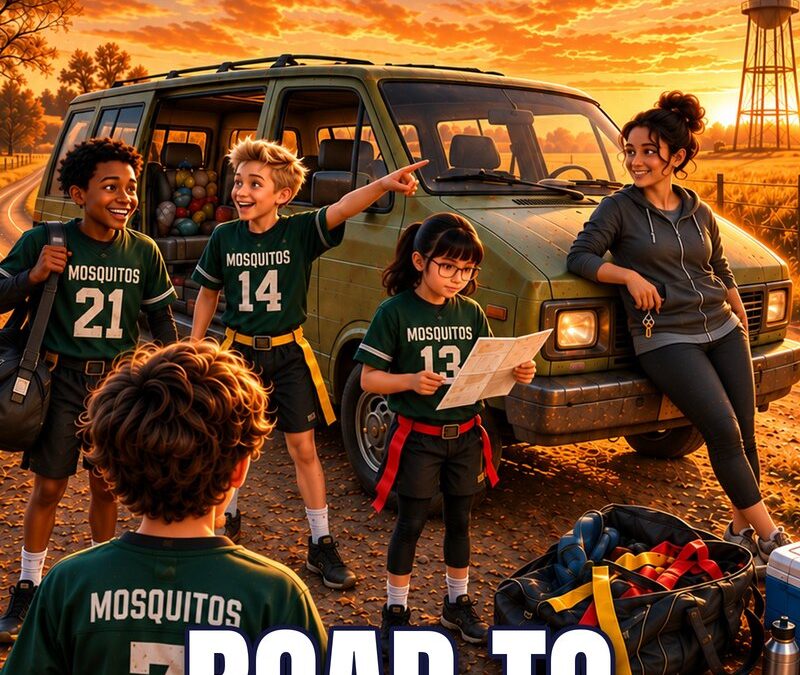
Your team has just won the state semifinal. Then Danny comes running with an envelope: the National Flag Championship at Bellhaven Fields, two states away, kicks off tomorrow at 9:00 a.m. Coach Ruiz is stuck in Denver with a cancelled flight. Nobody's parents can drive. The only driver left is Danny's nineteen-year-old sister, Nia, and a van with a bad door.
You are Cami Reyes, and every decision on this trip is yours. Which road do you take? Do you trust the stranger with the shortcut? What do you do when the clock starts running out? Choose well and you walk onto the field with your flag belts, your playbook, all four players and time to spare. Choose badly and the season ends on the side of a highway.
This one is a road trip as much as a sports story, which makes it a good pick for the child who likes the team more than the tactics. The best endings are hard to reach, and one of them is hidden — which is exactly the kind of thing a competitive kid cannot leave alone. Over 12 endings, full-colour illustrations throughout. Road to Nationals on Amazon.
Why the format works for kids who would rather be playing
- It has a score. Not literally, but a gamebook has a result: you found the good ending or you did not. A sporty child understands that instantly, in a way they do not understand "read to the end of chapter four".
- The sections are short. A page or two, then a decision. It is the reading equivalent of a drill rather than a lecture — which is the attention span most of these kids have off the pitch.
- They get to be the captain. The appeal of sport for many children is agency: the ball is in your hands. A book that hands them the ball does the same thing on paper.
- Losing is allowed. Plenty of endings are defeats, and the book does not pretend otherwise. Kids who play sport already know that, and they respect a story that knows it too.
How to get it into their hands
Do not present it as reading. Present it as a game: "you're the captain, see if you can get the team to the final". Read the first section and the first decision together, then leave the book on the kitchen table, where the cereal box lives. If the first read ends in a loss — and it often does — that is the moment to say nothing at all and let them go back in.
Both books are written for ages 7-12 and come as Kindle ($3.99), paperback ($10.99) and hardcover ($29.99). Browse the full collection for the rest of the series, or test the format for free with The Portal. And if your child is the one who says they hate reading full stop, this guide is the place to start.